
From Compilation to Execution: Designing a Complete System (Compiler + Processor)


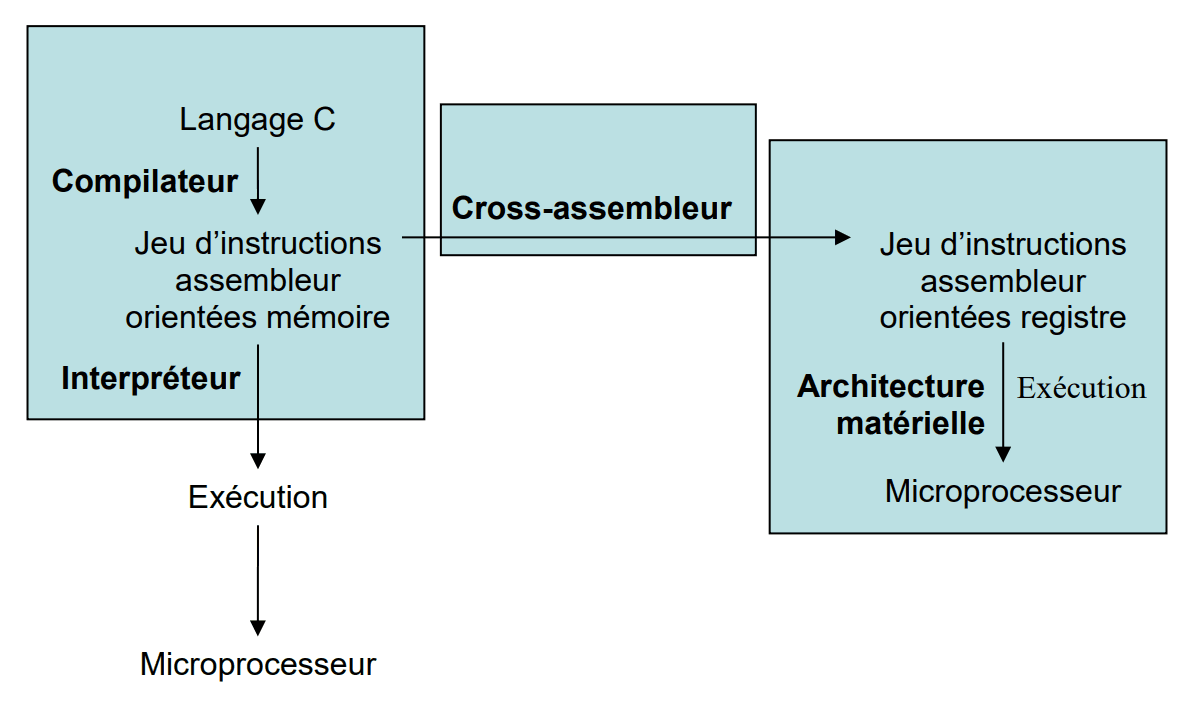
As part of an engineering project, we had the opportunity to design an end-to-end computer system: from defining a high-level source language to its simulated execution on a pipelined processor. This project allowed us to explore all layers of system computing: compilation, assembly, hardware architecture, memory management, instruction execution, and even data hazard detection.
Project Objective
Our work was based on two main pillars:
- Create a compiler translating a C-like language into memory-oriented assembly.
- Design a processor capable of executing register-oriented assembly code via a pipeline architecture.
Between these two worlds, we also developed a cross-compiler and an interpreter, which allowed us to chain all transformation stages of a program.
Part I - Compiler Design (LEX/YACC)
The source language is deliberately simple but close to C: it includes int and bool types, conditions, loops (for, while, do-while), and most common operators.
Great attention was paid to intermediate code optimization, particularly in temporary variable management.
| C Example | Unoptimized Code | Optimized Code |
|---|---|---|
int a = 2; | MOVi 0 2MOV 1 0 // @a = 1 | MOVi 0 2 // @a = 0 |
int a = 2 + 2; | MOVi 0 2MOVi 1 2ADD 2 0 1 | MOVi 0 2MOVi 1 2ADD 0 0 1 |
bool a = (4+5) <= (10-1) | ... | LE 0 0 1 // @a = 0 |
The if/else, for, and while blocks are managed with temporary addresses that the compiler fills dynamically after parsing, ensuring smooth execution without erroneous jumps.
Part II - Memory-Oriented Assembler & Interpreter
The compiler output format follows a fixed structure OP @A @B @C, with each instruction encoded on 32 bits. Here are the most commonly used instructions:
| Category | Available Instructions |
|---|---|
| Arithmetic | ADD, SUB, MUL, DIV, MOD |
| Logical | AND, OR, NOT |
| Comparators | EQ, NEQ, LT, LE, GT, GE |
| Flow Control | JMP, JMPZ, JMPNZ, CALL, RET |
| Miscellaneous | MOV, MOVi, PRI, INCO, DECO |
The interpreter executes this assembly code line by line by simulating memory, an instruction pointer, and classic processing operations.
Part III - Pipelined Processor Design
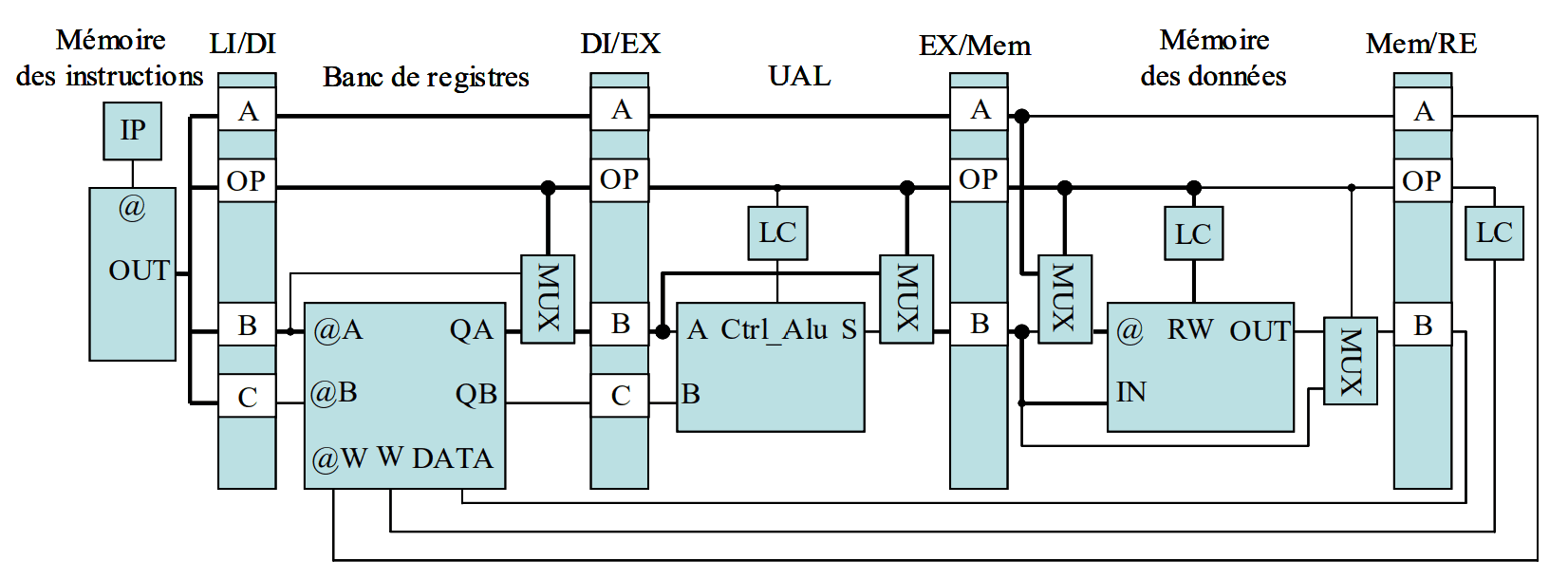
We developed a 5-stage architecture: Fetch, Decode, Execute, Memory, and Write Back. Each stage is implemented modularly, with fine-grained register conflict management.
Among the key components:
- The ALU performs all operations, taking into account the
Z,N,O,Cflags. - The ROM contains instructions to execute.
- The RAM allows temporary storage.
- A bank of 16 registers stores 8-bit data.
- The
data_hazards_managerdetects concurrent register reads and inserts NOPs when necessary.
Part IV - Cross-compilation (memory → register)
The initial compiler generates memory-oriented code. To execute this code on our register-oriented processor, we designed a Python cross-compiler.
The principle: replace each memory instruction with an equivalent register sequence, inserting load and store instructions.
| Memory Code | Equivalent Register Code |
|---|---|
ADD @A @B @C | LDR 0 @BLDR 1 @CADD 1 1 0STR @A 1 |
This mechanism allows automatic transformation of any code generated by our compiler into a program executable on the processor.
Part V - Final Integration and Testing
After modular component development, we validated the complete integration:
- Compilation of a source program to memory assembly
- Transformation by the cross-compiler to register assembly
- Code execution on the pipeline simulator
Each step produces an output file that becomes the input for the next step, enabling a reliable compilation chain.
Conclusion
This project was an intense and formative experience. It allowed us to touch both software layers (lexical, syntactic, semantic analysis, code generation) and hardware layers (architecture, execution, pipeline, registers).
We gained key skills:
- Language design with LEX/YACC
- Optimized and structured code generation
- Pipeline simulation and data hazard management
- Transformation from memory to register architectures
This work reflects our ability to design, code, test, and integrate complex systems.
Acknowledgments
We thank our supervisors for their support throughout the project. The work presented here was entirely carried out by our team, from compiler to processor, with rigor and passion.
You can find the complete source code for this project on our GitHub